☰ Strategic Framework
Why this study? Why now?
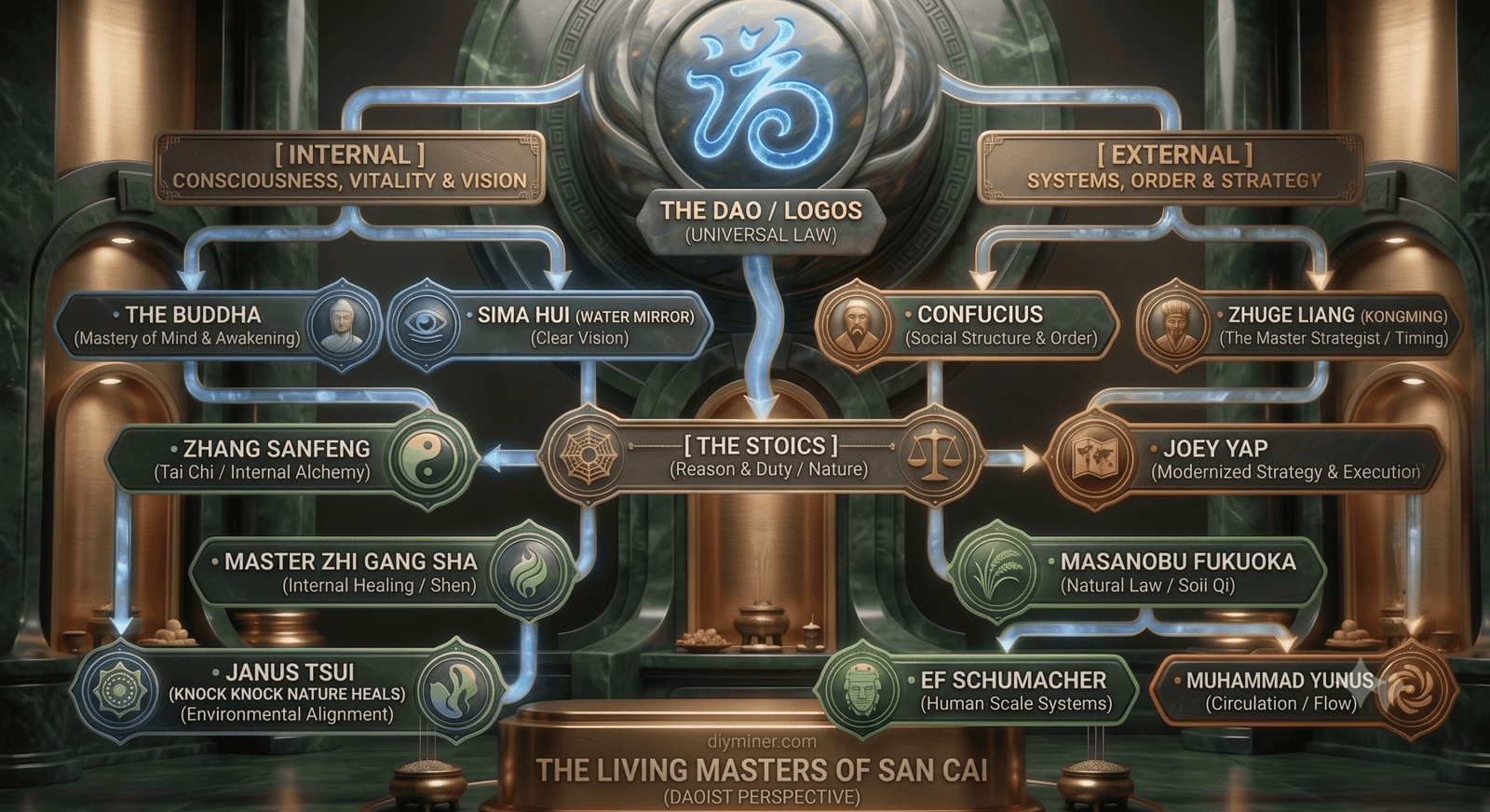
Our core Three Powers framework defines the universal laws of Heaven, Earth, and Man. But abstract laws are meant to be lived, not just studied.
To understand how these principles function without friction, we look to the individuals who serve as real-world manifestations of the system. They are the proof that when you align with natural law, bloat and forced effort disappear.
What phase are we in?
Learning and observation — suitable for any season. This study requires no outdoors, no materials, and no special timing. It is a Winter-friendly practice (inward, reflective) that also pairs well with the Wood phase (Spring) when you are deciding what kind of practitioner you want to become.
☰ Materials List
- A notebook or journal — for reflection notes.
- Access to a library or the web — for deeper research.
- A quiet hour — three sessions of 20 minutes each, or one uninterrupted hour.
- Optional: the Living Masters diagram — a visual map connecting each master to the Three Powers.
Total cost: $0.
☰ Quick Consultation Table
Find your situation below and jump to that master's biography and books.
| If you are facing... | Study | Power |
|---|---|---|
| A racing mind — you cannot think clearly | The Buddha | Heaven |
| A complex problem with no clear answer | Sima Hui | Heaven |
| Stagnation — you feel stuck or blocked | Zhang Sanfeng | Heaven |
| Low energy or depleted vitality | Master Zhi Gang Sha | Heaven |
| Your environment feels wrong — space, health, positioning | Janus Tsui | Heaven |
| Your soil or land is depleted. Where do you start? | Masanobu Fukuoka | Earth |
| Your project or system has grown bloated | E.F. Schumacher | Earth |
| Resources are stuck — energy or money is not circulating | Muhammad Yunus | Earth |
| You need to build shelter — durable, low-cost, from the land itself | Nader Khalili | Earth |
| You need a design framework for aligning your land with natural patterns | Bill Mollison | Earth |
| Your land seems impossible — too steep, too poor, too dry | Sepp Holzer | Earth |
| You need structure, order, or social discipline | Confucius | Man |
| External chaos — you need to stay calm and reasoned | The Stoics | Man |
| A complex plan that must be executed perfectly | Zhuge Liang | Man |
| Ancient wisdom that needs to work in a modern context | Joey Yap | Man |
| Ancestral traditions feel distant — you need them in modern language | Shimmy Xie | Man |
☰ The Heaven Manifestation (Tian)
Heaven governs timing, environmental awareness, and unclouded consciousness.
🏔️ The Buddha (Siddhartha Gautama, c. 5th century BCE)
The Buddha was born a prince in what is now Nepal and abandoned his royal life after encountering old age, sickness, and death. For six years he sought enlightenment through extreme asceticism before finding the Middle Way — a path between indulgence and deprivation. Sitting under the Bodhi tree, he resolved not to rise until he understood the nature of suffering. By dawn he had awakened.
His teaching — the Four Noble Truths and the Eightfold Path — is a direct method for clearing away the internal noise that keeps us from seeing reality as it is. This is pure Heaven work: stilling the mind so that timing and truth become visible.
Key works:
- The Dhammapada — the Buddha's essential sayings. View on Amazon
- What the Buddha Taught by Walpola Rahula — the best single-volume introduction. View on Amazon
💧 Sima Hui (Sima Hui, 2nd–3rd century CE)
Sima Hui, nicknamed "Water Mirror" (Shuǐ Jìng), was a hermit scholar during the late Eastern Han dynasty. He lived as a recluse in the countryside, but his clarity of perception was so respected that warlords and generals sought his counsel. He was the teacher of several of the era's greatest strategists — including Zhuge Liang and Pang Tong — and it was Sima Hui who recommended them to Liu Bei, setting in motion the events of the Three Kingdoms period.
His nickname "Water Mirror" captures his Heaven quality perfectly: still water reflects without distortion. When the mind is quiet, it mirrors reality exactly. Sima Hui did not act — he saw. And his seeing was enough to shape history.
Key work:
- Sima Hui appears in Luo Guanzhong's Romance of the Three Kingdoms. View on Amazon
🌀 Zhang Sanfeng (c. 12th–14th century CE)
Zhang Sanfeng is a semi-legendary Daoist master credited with founding Tai Chi Chuan (Taijiquan) and the Wudang school of internal martial arts. According to tradition, he lived from the Song dynasty through the Yuan dynasty — a life spanning over 170 years. He is said to have developed Tai Chi after observing a crane fighting a snake: the snake's soft, yielding movements overcame the crane's force. This insight — that yielding overcomes force — became the basis of all internal martial arts.
Zhang Sanfeng also wrote extensively on internal alchemy (Neidan), the practice of refining Jing into Qi and Qi into Shen. His Heaven quality is the ability to find balance through stillness and fluid change — to move without forcing, to flow without resistance.
Key works:
- Introduction to Tai Chi and Wudang Short Form. View on Amazon
- The Tao of Tai Chi by Jou Tsung Hwa. View on Amazon
✨ Master Zhi Gang Sha (b. 1952)
Dr. Zhi Gang Sha is a Chinese-born medical doctor, healer, and spiritual teacher now based in Canada. Trained in both Western medicine and traditional Chinese medicine, he developed the "Soul Healing" system — a method that works directly with the Shen (spirit) level rather than the physical body. He has written over 30 books, including eleven New York Times bestsellers.
His work focuses on clearing blockages at the soul level so that Qi flows freely and the body can heal itself. His Heaven quality is the recognition that the highest layer — spirit — governs everything below it. Clear the Shen, and the Jing and Qi follow.
Key works:
- Soul Healing. View on Amazon
- The Power of Soul. View on Amazon
- Soul Mind Body Medicine. View on Amazon
🌿 Janus Tsui (contemporary)
Janus Tsui is a TikTok and YouTube influencer, holistic health practitioner, and a living example of environmental alignment. Her work focuses on Qigong, Traditional Chinese Medicine (TCM), natural botanical remedies, and the art of positioning physical health and living spaces in accordance with natural energetic flows.
Her content reaches a modern audience through short-form video — translating ancient Daoist principles (Qi, Wu Wei, alignment with nature) into daily practices that require no dogma, no temple, and no special equipment. She is proof that the old patterns can live in new media.
Her Heaven quality is the recognition that Heaven's pattern is written into the landscape — and into the body. Read the land, read your energy, and you know what is possible. She represents the Heaven layer: the diagnostic of timing, environmental awareness, and unclouded consciousness.
Key works:
- Follow Janus Tsui on TikTok and YouTube for daily Qigong, TCM, and alignment content. Search "Janus Tsui Qigong" for guided practices.
☰ The Earth Manifestation (Di)
Earth governs physical reality, tangible systems, and resource efficiency.
🌾 Masanobu Fukuoka (1913–2008)
Masanobu Fukuoka was a Japanese farmer, philosopher, and the originator of "natural farming" (shizen nōhō). After a near-death experience in his twenties, he abandoned his career as a scientist and returned to his family farm to develop a method of agriculture that worked with nature rather than against it. For over 60 years, he demonstrated that a farmer could produce rice, barley, and vegetables as abundantly as conventional farms — without plowing, without pesticides, without fertilizers, and without weeding.
His system is sometimes called "do-nothing farming," but the phrase is misleading. It is not lazy — it is precisely observant. Fukuoka scatters seed pellets by hand, allows clover and straw to suppress weeds, and trusts the soil's ecosystem to do the work that machines and chemicals do on industrial farms. He proved that maximum yield can come from minimum interference.
His Earth quality is absolute: he worked with what was at hand, trusted natural processes, and built a system that ran itself. No synthetic inputs. No waste. No bloat.
Key works:
- The One-Straw Revolution — his essential book. View on Amazon
- The Natural Way of Farming. View on Amazon
- Sowing Seeds in the Desert. View on Amazon
📏 E.F. Schumacher (1911–1977)
Ernst Friedrich Schumacher was a German-born British economist who became one of the first and most influential critics of industrial capitalism. His core insight was devastatingly simple: the systems we build must be proportionate to the humans they serve. He called it "Buddhist economics" — an approach that measures prosperity not by production and consumption, but by health, sustainability, and meaningful work.
His 1973 book Small Is Beautiful argued that large-scale, centralized systems inevitably create bloat, waste, and human alienation. The solution, he said, is "production by the masses, not mass production" — right-sized tools, local economies, and technologies that ordinary people can understand and control.
His Earth quality is the discipline of right-sizing. When a system grows beyond human scale, it ceases to serve humans. Schumacher shows us how to cut away the bloat and return to what is necessary.
Key works:
- Small Is Beautiful: A Study of Economics As If People Mattered. View on Amazon
- A Guide for the Perplexed. View on Amazon
🤝 Muhammad Yunus (b. 1940)
Muhammad Yunus is a Bangladeshi economist and Nobel Peace Prize laureate who pioneered the concept of microcredit. As a young professor in the 1970s, he noticed that poor villagers in Bangladesh were trapped in cycles of debt because no bank would lend them the tiny sums they needed — $27, in one famous instance. He lent the money himself, from his own pocket. The borrowers repaid every cent. From this seed grew the Grameen Bank, which has since lent billions of dollars to millions of borrowers, most of them women, with a repayment rate above 98%.
Yunus proved that small, well-targeted resources — circulated rather than hoarded — can lift entire communities. His Earth quality is the understanding that flow and circulation are the lifeblood of any system. Money is like water: stagnant it breeds decay; moving it nourishes everything in its path.
Key works:
- Banker to the Poor — his autobiography. View on Amazon
- Creating a World Without Poverty. View on Amazon
- A World of Three Zeros. View on Amazon
🏠 Nader Khalili (1936–2008)
Nader Khalili was an Iranian-born American architect, author, and the founder of the Cal-Earth Institute. He developed Superadobe — a construction method using sandbags, barbed wire, and on-site earth to build durable, dome-shaped homes that are fireproof, flood-proof, and earthquake-resistant. No lumber. No industrial materials. No heavy machinery. A small team can build a shelter in days.
Khalili's insight was deeply Daoist: instead of shipping materials to the site, use the site itself. The earth beneath your feet is the building material. The only energy required is human labor working with gravity and compression. His Superadobe system received a patent and was approved by the United Nations for refugee housing — but its real power is as a blueprint for anyone who wants to build shelter without debt.
His Earth quality is the ultimate proof that shelter can come from the ground, not from a factory. He fills a gap the lineage needed: building. Agriculture (Fukuoka), economics (Schumacher), social systems (Yunus) — and now structure.
Key works:
- Racing Alone — his visionary autobiography. View on Amazon
- Ceramic Houses and Earth Architecture: How to Build Your Own. View on Amazon
🌿 Bill Mollison (1928–2016)
Bill Mollison was an Australian researcher, author, and the co-founder of the permaculture design system. Along with David Holmgren, he developed permaculture as a replicable framework for aligning human systems — farms, gardens, homes, communities — with the patterns of natural ecosystems.
Where Fukuoka demonstrated Wu Wei on his own farm, Mollison systematized the approach so anyone could apply it anywhere. His core principles — "observe and interact," "catch and store energy," "use small and slow solutions," "produce no waste" — are strikingly Daoist in spirit. They give the visitor a ready-made vocabulary for San Cai and Wu Wei that connects the temple's teachings to the wider land-stewardship world.
His Earth quality is methodology: he built the bridge between observation and design. His work is the practical toolkit that lets a visitor move from "I see the pattern" to "I design with it."
Key works:
- Permaculture: A Designers' Manual — the essential reference, known as "The Bible of Permaculture." View on Amazon
- Introduction to Permaculture. View on Amazon
⛰️ Sepp Holzer (b. 1942)
Sepp Holzer is an Austrian farmer, author, and international permaculture consultant known as the "Rebel Farmer." He transformed his family's mountain farm — steep Alpine slopes at 1,500 metres elevation where conventional agriculture was deemed impossible — into a thriving food forest with over 10,000 fruit trees, productive terraces, and natural water management. He did it without irrigation, without chemical fertilizers, and without pesticides.
Holzer's method is pure Wu Wei: he watched where water flowed, where frost settled, and what plants volunteered naturally — then he worked with those patterns instead of fighting them. When the Austrian government fined him for not following regulations, he didn't argue. He planted more trees and let the results speak. His story is dramatic proof that natural-law alignment works under extreme conditions, not just in mild climates.
His Earth quality is the narrative of possibility: if a barren Alpine slope can be transformed by watching and listening, any piece of land can. He is Fukuoka's European counterpart — louder, more defiant, but rooted in the same principle: trust the land, don't force it.
Key works:
- Sepp Holzer's Permaculture: A Practical Guide to Small-Scale, Integrative Farming and Gardening. View on Amazon
- Desert or Paradise: Restoring Endangered Landscapes Using Water Management. View on Amazon
☰ The Man Manifestation (Ren)
Man is the tactical pivot — the discipline and calculated strategy required to bridge the other two.
📜 Confucius (Kongzi, 551–479 BCE)
Confucius was a Chinese philosopher whose teachings have shaped East Asian civilization for over two thousand years. Unlike the Daoist sages who looked to nature, Confucius looked to human relationships. He taught that order begins not with laws or governments, but with the cultivated individual — the junzi, or "exemplary person." Right action, proper ritual, filial piety, and sincerity were the foundations of a harmonious society.
His teachings — collected by his students as The Analects — are earthily practical: how to treat your parents, how to govern, how to learn, how to be a friend. He did not claim divine revelation. He claimed only that the Way (Dao) could be walked through disciplined human action.
His Man quality is the belief that structure, ritual, and discipline are not constraints — they are the scaffold on which freedom is built.
Key works:
- The Analects of Confucius — the essential collection of his sayings. View on Amazon
- Also recommended: Simon Leys translation. View on Amazon
⚖️ The Stoics (Marcus Aurelius, Epictetus, Seneca, c. 1st–2nd century CE)
Stoicism is a Hellenistic school of philosophy centered on the idea that we cannot control external events — only our responses to them. Its three best-known figures each embody a facet of Man discipline:
- Marcus Aurelius (121–180 CE) was a Roman emperor who wrote his Meditations in Greek while on military campaign — a private journal of self-discipline, duty, and acceptance of fate. He is the ruler who refused to be corrupted by power.
- Epictetus (c. 50–135 CE) was born a slave. After gaining his freedom, he taught that freedom is not external but internal: no one can control your mind unless you let them. His Discourses and Enchiridion (Handbook) are manuals for inner freedom.
- Seneca (c. 4 BCE–65 CE) was a statesman, playwright, and tutor to Nero. His Letters from a Stoic are practical essays on how to live with integrity in a corrupt world.
Their Man quality is the ability to navigate chaos with reason, to choose response over reaction, and to maintain internal order when the external world is disordered.
Key works:
- Meditations by Marcus Aurelius. View on Amazon
- Letters from a Stoic by Seneca. View on Amazon
- Discourses and Selected Writings by Epictetus. View on Amazon
- Boxed set: Major Works of the Stoics (all three in one). View on Amazon
🎋 Zhuge Liang (181–234 CE)
Zhuge Liang (also known as Kongming) was a chancellor, military strategist, inventor, and scholar during the Three Kingdoms period of China. He is widely regarded as the most brilliant strategist in Chinese history. Before entering service, he lived as a recluse farmer — until Liu Bei visited him three times and persuaded him to leave his fields and become his chief advisor.
As strategist for the Shu Han kingdom, Zhuge Liang masterminded campaigns against overwhelming odds, using timing, terrain, and psychological insight to compensate for limited resources. He invented the repeating crossbow, the land mine, and a transport vehicle called the "wooden ox." He is famous for the "Empty Fort Strategy" — leaving his gates wide open to convince a vastly superior enemy that it must be a trap.
His Man quality is the fusion of brilliant planning with flawless execution. He proves that meticulous timing and precise calculation allow you to complete complex tasks seamlessly — even with limited resources.
Key works:
- His story is told in Romance of the Three Kingdoms by Luo Guanzhong. View on Amazon
- Mastering the Art of War by Zhuge Liang and Liu Ji (strategic writings attributed to him). View on Amazon
🧭 Joey Yap (b. 1977)
Joey Yap is a Malaysian-born Chinese metaphysical practitioner, bestselling author of over 180 books, and the world's leading authority on the practical application of classical Chinese metaphysics. He is the founder of the Mastery Academy of Chinese Metaphysics, which has taught tens of thousands of students across the globe.
What distinguishes Yap is his ability to translate ancient systems — BaZi (Eight Characters), Mian Xiang (Face Reading), Xuan Kong (Flying Stars), and Qi Men Dun Jia — into clear, modern, actionable practice. Where many teachers keep Chinese metaphysics shrouded in mystery, Yap demystifies it. Where others speak only to initiates, he speaks to anyone willing to learn. He has made classical strategy directly applicable to modern career decisions, business timing, and personal relationships.
His Man quality is translation: taking Heaven's patterns and Earth's systems and turning them into decisions a single human being can act on, today.
Key works:
- Joey Yap's Art of Face Reading. View on Amazon
- BaZi: The Destiny Code. View on Amazon
- The Chinese Five Elements Oracle. View on Amazon
📜 Shimmy Xie (contemporary)
Shimmy Xie is a content creator, dancer, and author who shares Chinese ancestral wisdom through TikTok, YouTube, and her book Ancestral Wisdom of Chinese. Her work focuses on traditional Chinese philosophy, ancestral healing practices, and Eastern spirituality — translated into accessible, social-media-friendly formats for a modern audience.
Where Janus Tsui leans toward embodied practice (Qigong, TCM), Shimmy Xie focuses on the transmission of ancestral knowledge itself — making ancient Chinese wisdom feel relevant and usable in daily life without requiring years of study. Her own practice as a dancer informs this work: movement, rhythm, and the discipline of the body become channels for ancestral memory. She bridges the gap between "this is old knowledge" and "this applies to your life right now" — through both her words and her movement.
Her Man (Ren) quality is translation: she makes the ancestral accessible. She proves that ancient patterns do not need to stay locked in texts — they can live in short videos, in dance, in modern language, in the palm of your hand.
Key works:
- Ancestral Wisdom of Chinese — her book. View on Amazon
- Follow her on TikTok and YouTube for daily ancestral wisdom and dance content.
☰ Where This Fits in the Temple
This study extends the Three Powers method with living examples. Each master named here is a window into a specific practice:
- 🌤️ Three Powers — The structure itself. Heaven, Earth, Man as a diagnostic lens, now populated with real human expressions.
- 🏔️ Three Sacred Treasures — The internal practices (Shen clearing, Jing building, Qi cultivation) are directly reflected in the Heaven masters (Zhang Sanfeng, Master Sha).
- 🌊 Five Elements — Many of these masters align with elemental energies: Sima Hui (Water clarity), Zhuge Liang (Metal precision), Fukuoka (Earth patience).
- ⚛️ Wisdom Reactor — When facing a decision, you can ask, "Which of these masters would I consult?" and choose the perspective that matches.
- 🌉 The Bridge — This study itself is a hinge: connecting abstract philosophy to tangible people you can study.
Your Practice
For the next month, keep one eye on the masters you studied. When you face a decision, return to the Quick Consultation Table above. Find your situation. Study that master. Read their book if you want to go deeper. Ask: What would they do?
Not to imitate them, but to borrow their clarity until it becomes your own. The masters are not statues to admire — they are lenses to see through.
What to expect
First session: You may not know all the names. That is fine — choose one master that resonates with your current situation and research their life. One master studied deeply is worth more than twelve skimmed.
After studying all three Powers: One of the three will feel like home. One will feel uncomfortable. That discomfort is the pointer — it shows where your practice is needed.
Over time: You will begin to see San Cai in everyone you meet. A neighbour who always knows when to speak (Heaven). A friend who can make a meal from an empty pantry (Earth). A stranger who steps in quietly to help without being asked (Man). The masters are everywhere.
🌐 A quiet reflection from the temple. Return to diyminer.com for more free methods.
This blueprint is free. Always.
If this study helped you see San Cai more clearly, you can support the temple's ongoing work. Any amount feels right. No obligation.
☕ support the work more blueprints
Prefer a printable PDF? Download The Living Masters of San Cai PDF (free with email sign-up).